
What is a DXP: Introduction to AmplifyUP
AI-Assisted Proofreading
All articles on this site are written by me. I use AI tools solely for proofreading and editing assistance to ensure clarity and accuracy.
About a year ago I decided to take on a fun new challenge with AI: to build something that I've worked on and understand from a high level to see if I could build most of those parts from the ground up with AI. Today I start a series where I talk more about that project and the learnings I've had working on it. With AI my role has definitely shifted. No longer do I spend time writing much code myself, but that doesn't mean I don't know what is being written, it just means I don't need to know every last detail. Now I've shifted to more of a Product Owner/Manager and QA role, and there is still a need for understanding architectural decisions.
The journey I went down was to see if I could build my own DXP. It wasn't quite this goal in the beginning, because I just wanted to see what was involved in building a good solid visual builder and incorporating a Customer Data Platform (CDP) as well into that mix. As the project grew, it started turning and adding more capabilities as it went. Originally I planned to really just launch it as an open source project to the community, but as it progressed and I started using it for my own purposes, such as managing the content on my own blog, I realized maybe it wouldn't hurt to sell this as a product. And that's where I'm at today. We'll talk a little more about its capabilities and what capabilities should exist in a true DXP, but I also wanted to talk more about the product. Building software with AI comes with new challenges. The one I've struggled with is that since this platform is quite broad with features, how can I be sure it's secure and well tested, not just at any given point but also as I progress and layer in new features? This is where there has been a mix of my own knowledge combined with the creation of a new AI SDLC. Testing in an AI development world takes on a whole new meaning, because we can't catch everything but we definitely can layer on more and more testing to help determine when the product starts to drift from what's been currently built. I'll be sharing more about this process and what I've set up to automate this process and lead to a more stable product that's at the point where it could be sold to customers. Now we aren't launching the product today — it's still closed down. You can sign up for beta access, and I'll review and may give some folks limited access to play around with the tool. Preference will be given to either content creators planning to create content on the platform or customers that want to give it a try. The plan is that customers that plan to use it will pay $499/month for the first year at the baseline, and they will get 2M events and most of the platform up to a specific threshold. If you need/want more, then you pay for additional. I'm targeting customers at a mid-market price point that are looking for the same advanced capabilities of maybe a Sitecore or Optimizely without that same price.
What Parts Are In A DXP
Content
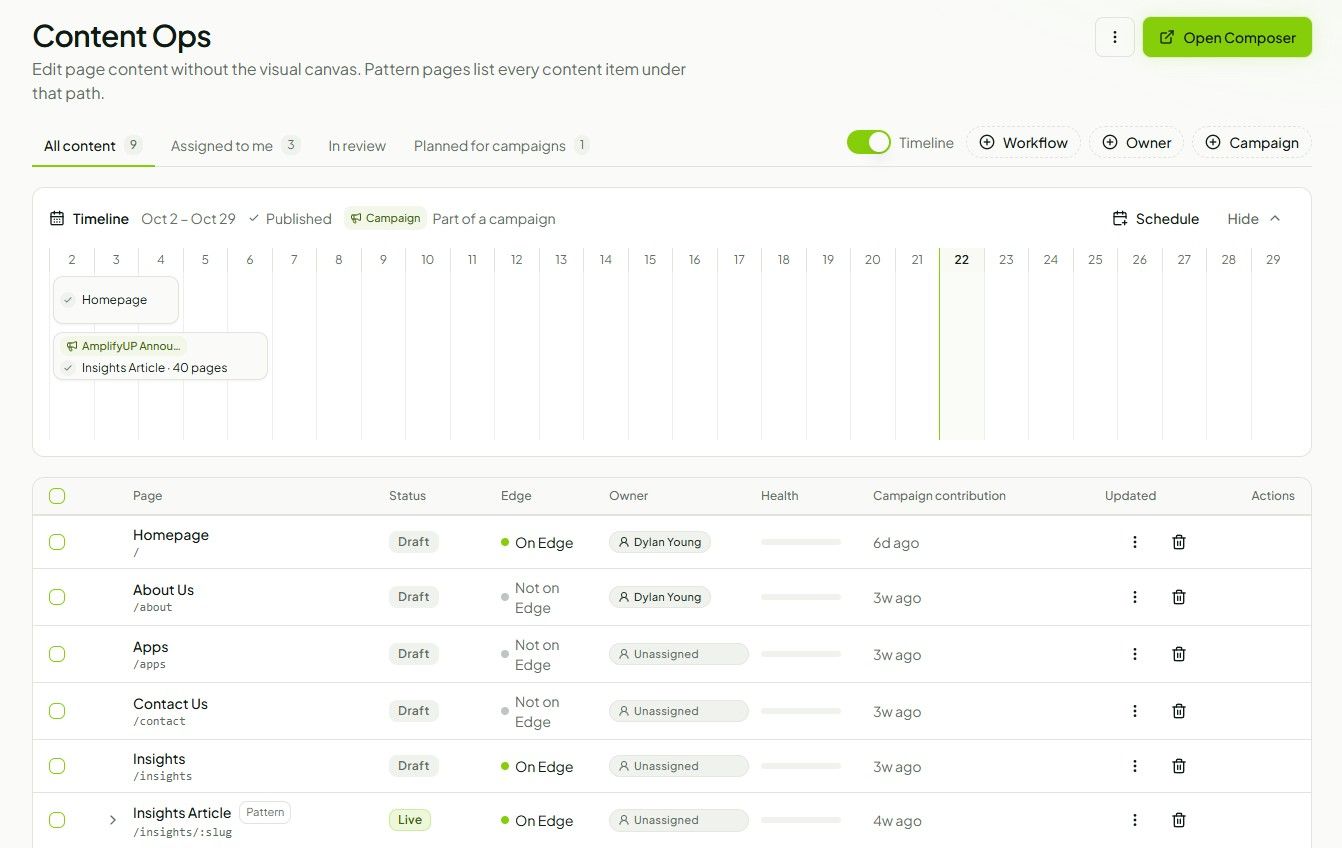
This is usually the most prominent part of a true DXP: a CMS suite. Now as of the time of this writing, AmplifyUP doesn't actually contain its own CMS, but plans are there to add this support. We actually have a platform that allows you to bring in your own CMS stacks and use it with our platform, even if you are on the free tiers of those stacks. We currently support Sanity.io and Contentful, but more are planned soon. But content goes deeper than just being able to create it. Usually a more modern DXP will come with an easy-to-use visual editor for directly editing content on the site. AmplifyUP includes such an editor, which honestly was one of the larger challenges when building this stack, but now works pretty well — though more bugs are to be identified and captured. We will be writing a blog soon that talks more about what is involved in creating your own editor and why it's more complex. In addition to a visual editor and CMS, there are many other areas around content, such as a way to support assets with a DAM. We don't currently have our own DAM, and honestly it makes more sense that you would use an industry-specific tool that you bring to our platform. It's currently on the roadmap to add support for Cloudinary and Bynder, but you can also bring in or manage assets in the CMSs we support today (Sanity and Contentful). Other capabilities include localization and multisite. We don't currently support localization, but we do support multisite scenarios — though things are always a work in progress, so as people start to use the stack, we'll discover gaps and start to fill those gaps with capabilities. We do have workflow and governance, which could fit into this section, but we'll cover that more in the Governance section. Lastly, we have Content Ops. Really, given that the visual builder is a specific page you're editing, the Content Ops section is a holistic view of scheduled posts/campaigns and the dashboard I envision content authors will use to assess the current state of the content on their website. The other part that makes up content in a DXP is delivery of that content. We have a full edge pipeline in Cloudflare, which can handle immense load and can actually handle at the edge materializing content from multiple sources in an efficient way. The edge provider we'll be covering in a future blog as well.
Taking some sneak peeks of this new product are below:
Amplify UP Visual Builder (while I wrote today's article)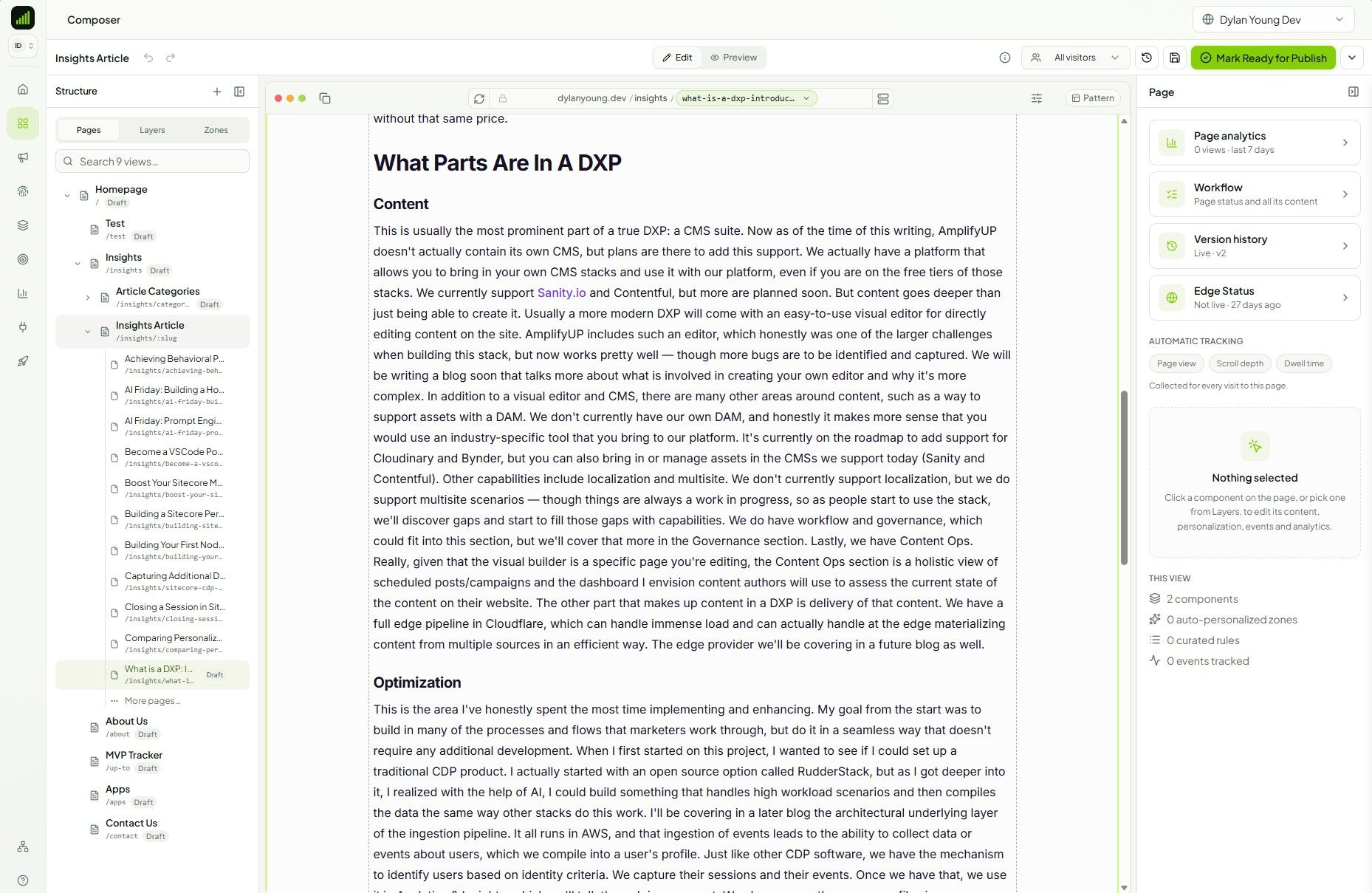 Content Ops: A dashboard tailored for the holistic view of your content vs the Visual Builder where you work on a specific piece of content.
Optimization
This is the area I've honestly spent the most time implementing and enhancing. My goal from the start was to build in many of the processes and flows that marketers work through, but do it in a seamless way that doesn't require any additional development. When I first started on this project, I wanted to see if I could set up a traditional CDP product. I actually started with an open source option called RudderStack, but as I got deeper into it, I realized with the help of AI, I could build something that handles high workload scenarios and then compiles the data the same way other stacks do this work. I'll be covering in a later blog the architectural underlying layer of the ingestion pipeline. It all runs in AWS, and that ingestion of events leads to the ability to collect data or events about users, which we compile into a user's profile. Just like other CDP software, we have the mechanism to identify users based on identity criteria. We capture their sessions and their events. Once we have that, we use it in Analytics & Insights, which we'll talk through in a moment. We also can use those user profiles in personalization and experimentation. We mentioned edge in the Content layer, but we also use edge here to return user-specific variation at the edge, so instead of worrying about painting the page and then shifting the page to return personalization and getting the flicker, we handle all that logic for you with either edge-side personalization or true edge personalization.
Also, with the data we are collecting, we are able to start using that information to make decisions or better understand our users via building personas and matching those to our audiences and building end-to-end flows/funnels for the usage of our website. We can capture unique insights using traits & signals. Obviously more on this to come, since there is quite a bit here to cover.
A view of Amplify UP's Optimization features: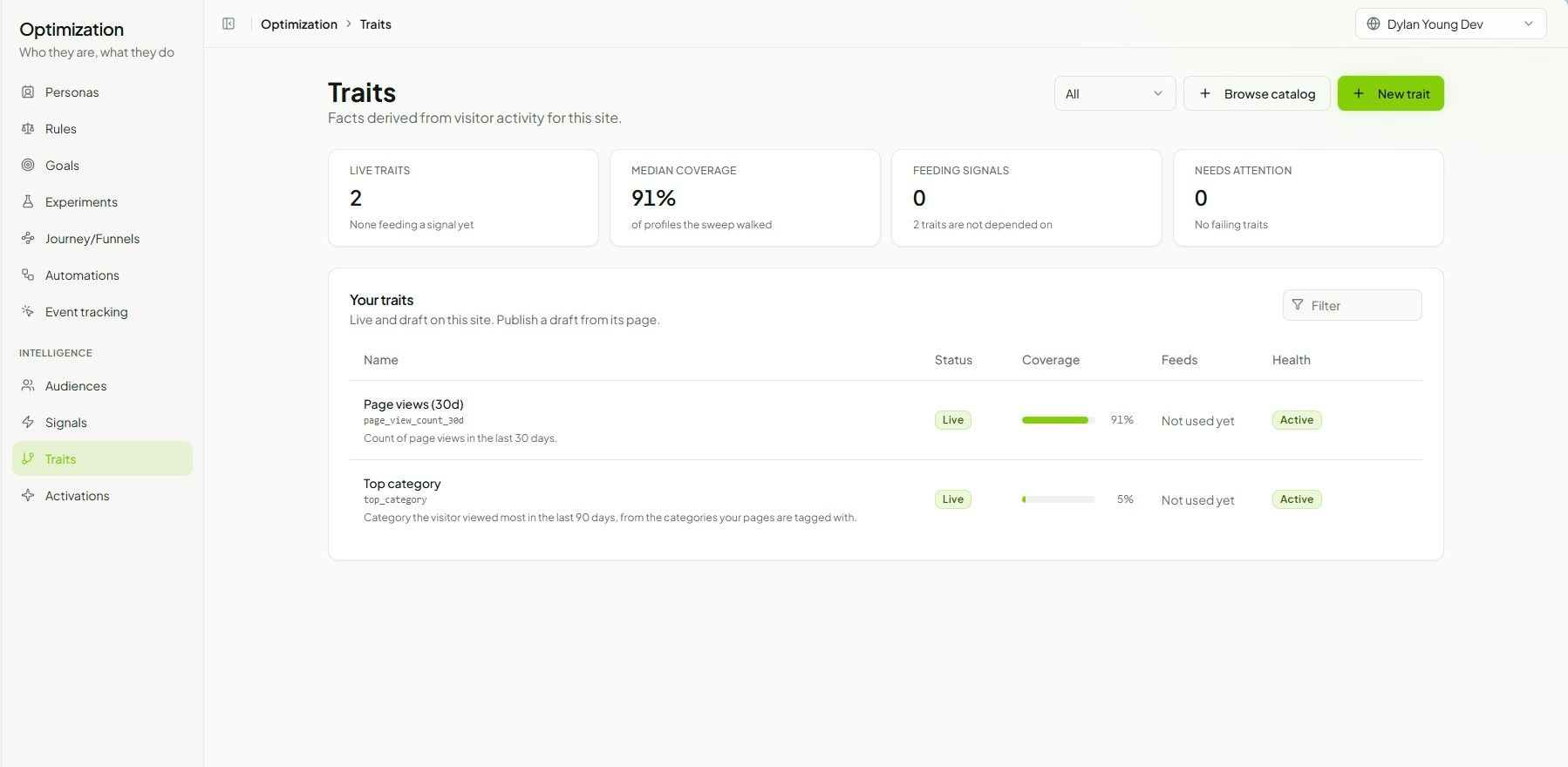
Marketing Automation
Another popular area that a large DXP should cover some of is marketing automation: basically the ability to take the insights collected from web properties and push those into other systems or even the same system to trigger actions outside the current platform. For example, this could be pushing content into SMS or email form, or triggering events in other systems, usually in a collaborative way. I saw some of this in the old Sitecore XP days, and there are a few DXPs that have these capabilities. I've also added a few capabilities to AmplifyUP that run alongside the Campaigns feature of the product. Right now it just helps curate social media pushes, but I have plans to also facilitate email, and with capabilities like event streaming, will enable a full ecosystem outside the product. Furthermore, extending our journeys/funnel capabilities to include the journey of a user outside any site property and allow for tracking in those use cases will help with this as well.
Search
A true DXP has some way to cover search for customers. Unfortunately, however, at this time I don't have an implementation of search. The plan, however, is to add support for Algolia in the coming weeks and months, just providing a mechanism where content in the platform can be consumed. However, due to the orchestration configuration, if you get search providers to index Sanity.io or Contentful content, it should work on this site. But more direct support will be coming, and if the demand is there, we'll likely add our own search provider built in, but likely as an add-on feature.
Analytics & Insights
For analytics and insights, it's important to not only collect events and data about your customers that visit the web properties but also use that information to make informed decisions. With AmplifyUP we have created dashboards and will be covering more on advanced dashboard capabilities soon, allowing you to unlock more of your own data and get that data into the platforms/systems you need it to be in. In addition, because we enable traits and signals, we help the customer improve what they can or should collect to unlock more capabilities in the product. Honestly, this was one of the areas I wanted to focus on the most, and it shows, and there is a lot more to come, especially with AI's ability to unlock more out of these parts as well.
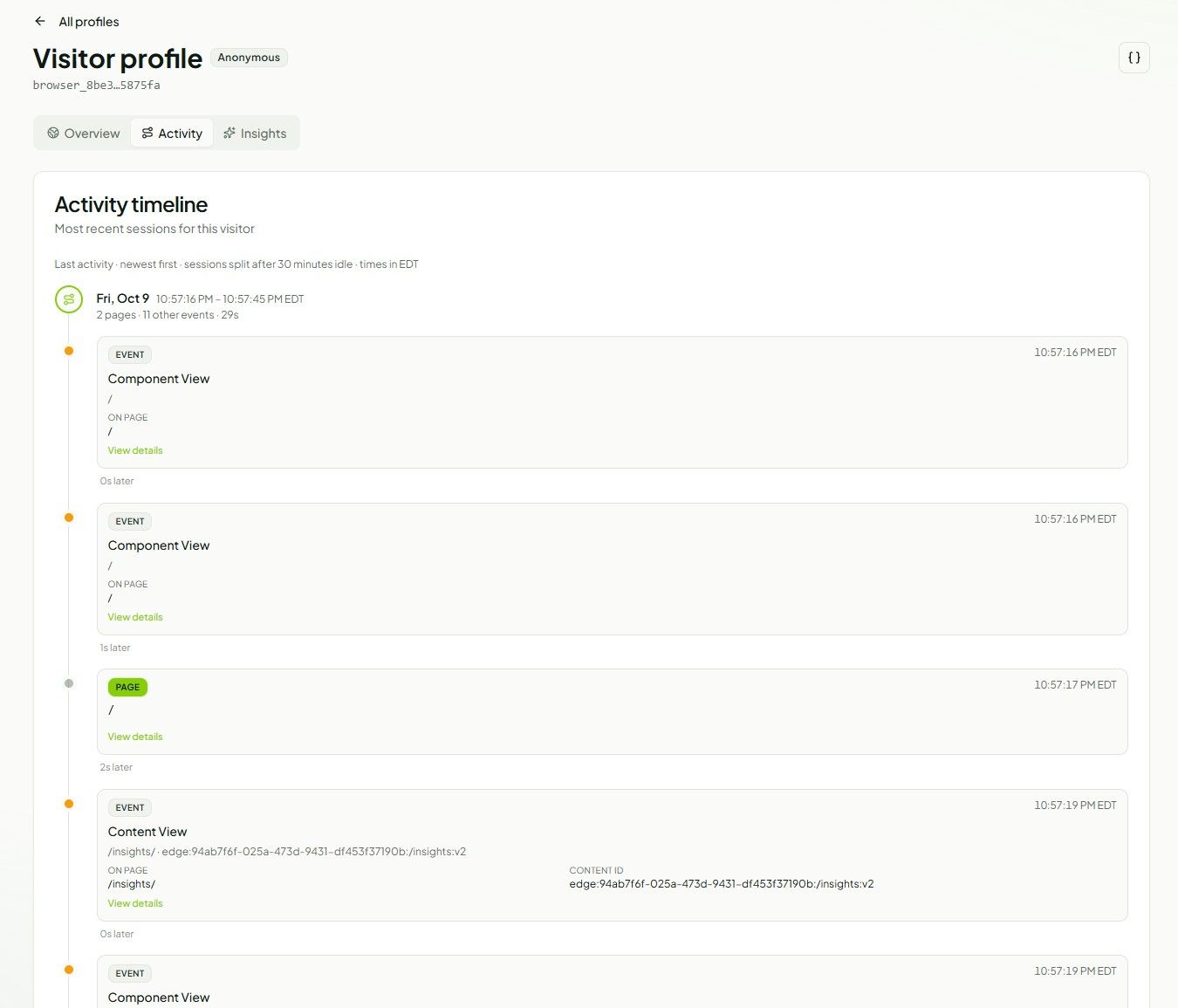
A view of Amplify UP Insights and CDP capabilities (all data is real tracked from my blog):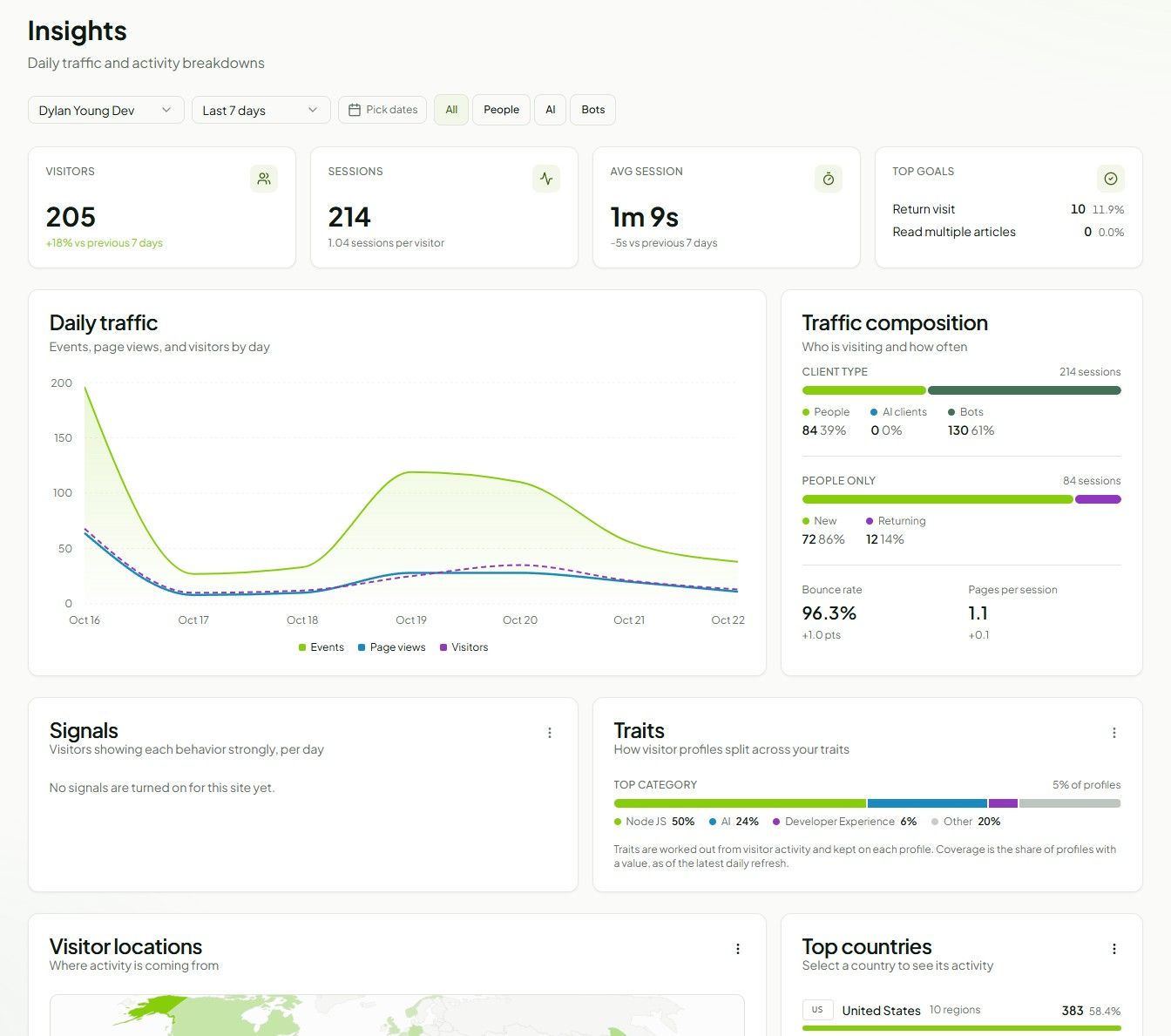 And Profiles which is the CDP capabilities: (No fake data, all tracked using our tracking script from dylanyoung.dev).
Campaigns
I've already mentioned it, but having a website that you manage content by content doesn't really follow the typical marketing life cycle for a website. Usually there are marketing campaigns, like an initiative to cut childhood obesity for a health organization for the current calendar year. Having the capabilities to not only group and ideate on that content but also keep track of those campaigns and get rich insights is a great capability for a DXP.
Campaigns, I think, is extremely important when it comes to planning your content for now and in the future. This comes from capabilities I use for my own blog but shifted into one platform. Ideate, and then plan and work on contributions for a campaign, and use a scheduler to keep track of when they are announced.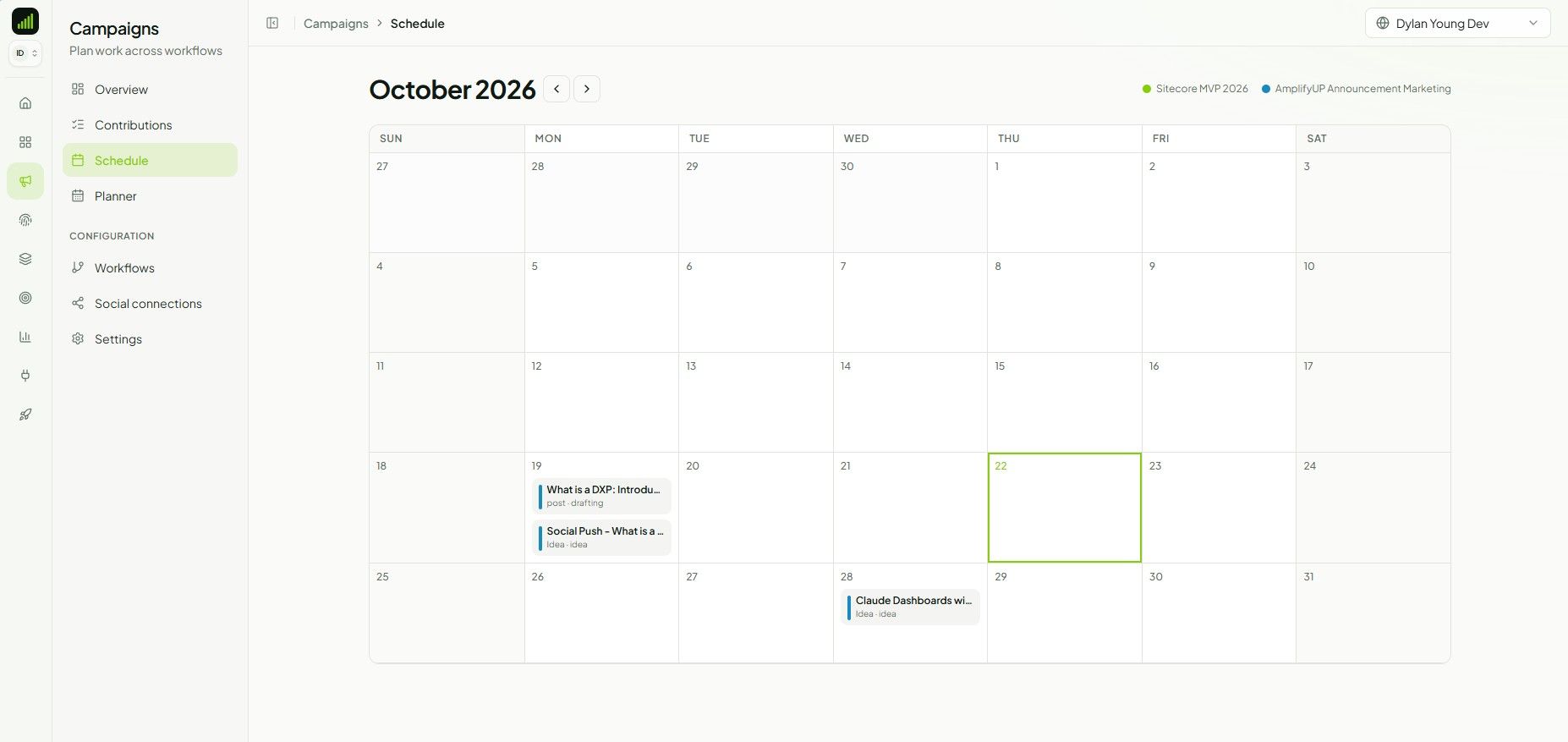
AI
Most modern DXPs now make a bet with how AI will impact the marketer, the content editor or even the developer using their DXP. Now I haven't done as much in this category as others, but I do have some guesses on where I think this is headed and where to make investments once I play catch up on the other parts of a true DXP. So I do have areas where AI is involved but I haven't made a major stake in where I think this will go for the product (yet), but it will be coming more and more.
Forms
This one is important. I feel like any DXP that launches a full suite for a website should have forms capabilities. Unlike other products that went SaaS and didn't launch these capabilities, we also have a forms product baked in today. It's an early version, but there will be more improvements coming including adding better governance over how PII data is collected and stored, and how it's handled, as well as working to make it easier for marketers to get insights from form submissions. Will have a blog on this specific feature to come in a few weeks.
AmplifyUP Forms - Drag and Drop and build a custom form to collect information and send that data to specific webhooks or back into the platform.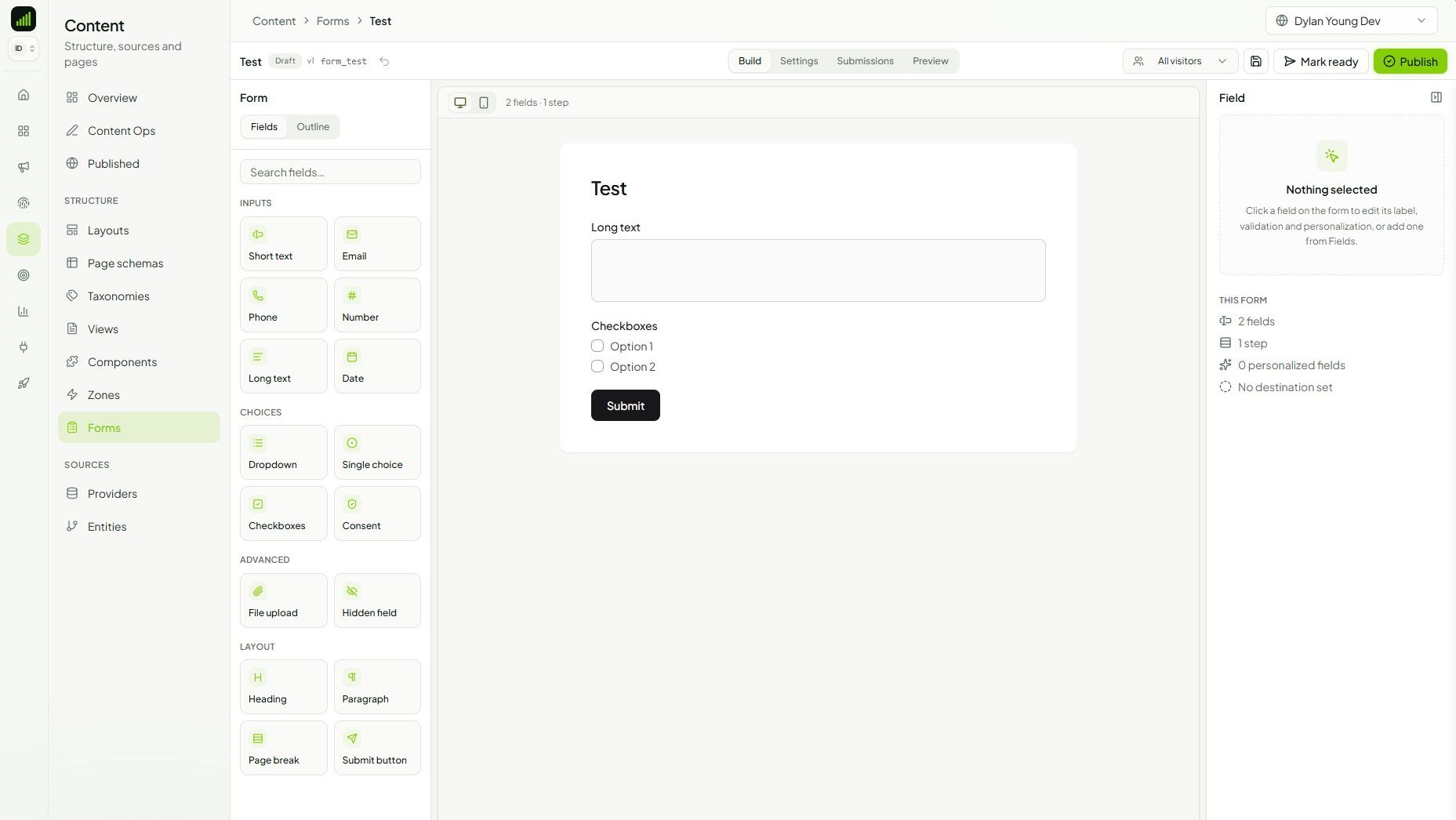
Governance
I think any major CMS platform, let alone a DXP, should have a good amount of governance, which starts with roles, and understanding the users of your platform and what they expect from your platform, which is different from a developer to a marketer. Once you have those roles you can start to restrict what they can control and work with. AmplifyUP provides a lot of this today, and more as was the case across the different features, is also the same as in it's currently on the roadmap to improve further. I've had the goal since I started this project, to give developers the flexibility to work how they would expect, but also give marketers the ability to do a whole lot more than I've seen most DXPs currently in the market allow without any additional development.
Wrap Up
With all that being said, Amplifyup.ai has made huge strides. It's pretty much ready now for a real customer to give it a go. Currently if you navigate to the site, you can only sign up for beta access, but feel free to reach out to me and show interest if you want to play with it, or you want to try it out for one of your business websites. I will be releasing a lot of new content on this new platform over the next few months, and this really just starts the kickoff to that. I had kind of wanted to have the app fully live taking payments for this announcement, but since I'm the only developer (except my team of AI agents building the platform), we are still working out the last bits before this goes live. Also, if you're a community member, and you'd like to create content on the platform, and be an early adopter to provide feedback, I am open to giving individuals, more than likely folks in the MVP community or in other evangelism roles, access to configure a site and use it to then share feedback and create content on the platform.